
- News
This bi-monthly news from a range of European stateless nations. July guest: A letter from Sicily.
NEWSLETTER
July 2026
Sicily
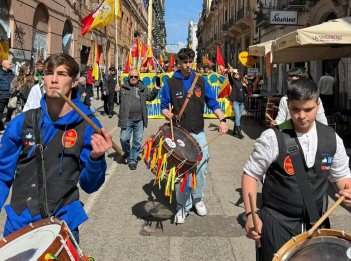
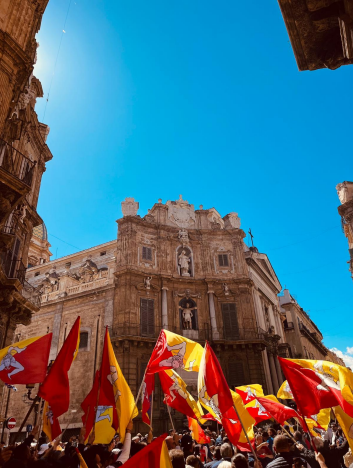
This April marks the return of the “Simana dû Sicilianu,” now in its latest edition and organized by Trinacria and Cademia Siciliana. The initiative represents a moment of collective participation aimed at calling for the official recognition of the Sicilian language. 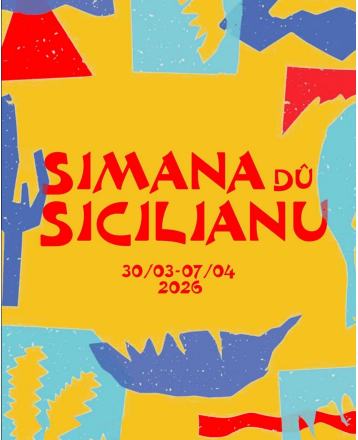
An event that continues to grow in strength, it highlights a demand increasingly shared by a large portion of the Sicilian people: to defend, promote and pass on a language that has too often been the target of stereotypes and prejudice.
Despite the fact that Sicilian is still spoken today by millions of people—both on the island and among emigrant communities abroad—it still lacks institutional recognition. All too often, its linguistic and literary history is denied or erased. The absence of political protections, the prejudices that threaten its use, and its reduction to the status of a “dialect” are the result of a long process of stigmatization which, particularly over the last century, has cast those who spoke Sicilian in a negative light. Its use has been associated with an idea of an inferior and backward culture, almost anachronistic, fostering a sense of shame and rejection that has been passed down to younger generations. This has also occurred through the systematic devaluation of literary production in Sicilian, beginning with its removal from school curricula, despite the language’s centuries-old and highly prestigious tradition.
Alongside this literary marginalisation is the widespread misconception that Sicilian is merely a “dialect” of Italian—an inaccurate definition, especially from a linguistic standpoint. Sicilian is not a variant of Italian (that is, Tuscan), but an autonomous and independent language, with its own history, grammar and syntax. Like Italian, it derives directly from Vulgar Latin and forms part of the Italo-Romance linguistic continuum. Yet the issue appears to be more political than linguistic: labeling Sicilian as a dialect imposes a negative connotation, relegating it to a supposedly “low” or minority culture. This stands in contrast to the recognition granted by international bodies such as UNESCO, Ethnologue, the Linguasphere Observatory and Glottolog, which classify Sicilian as a mother tongue and among Europe’s vulnerable languages.
At the same time, other minority languages spoken in Sicily, such as Arbëreshë and Gallo-Italic varieties, are officially recognized and protected. The reason is clear: recognizing Sicilian as a language would mean legitimizing a broader historical and cultural heritage. In an island that still maintains a strong sense of distinct identity in relation to the Italian state, such recognition would carry significant political implications, even before linguistic ones.
Another common stereotype links the Sicilian language to criminal environments. Sicilian tradition has often been associated with narratives of mafia and crime, but reducing the language and culture to such a narrow representation is deeply unfair. Until only a few decades ago, Sicilian was used across all sectors of society, including but not limited to criminal contexts, where certain codes have persisted over time. To confine its use primarily to such settings is a historical distortion that fails to reflect the dignity and prestige of the language. Too often, it is forgotten that for many speakers in diaspora communities, Sicilian is not merely a means of communication, but a powerful symbol of belonging and identity: for them, it is a first language, alongside that of their country of residence, carrying with it stories, traditions and values passed down through generations.
It is therefore essential to understand that Sicilian must no longer be perceived as a source of shame, but as a resource to be preserved and valued. Restoring its central place within the cultural landscape also means restoring to its speakers a deep connection with their past and their identity. It is from this need that organizations such as Cademia Siciliana at the forefront of the movement alongside Trinacria have emerged over the years, advocating for the recognition and promotion of Sicilian through concrete initiatives. Among these is the implementation of Regional Law 9/2011, which provides for the teaching of Sicily’s linguistic and cultural heritage in schools. If fully enacted through adequate funding, this law would help overcome the notion that speaking one’s mother tongue is synonymous with ignorance or backwardness, allowing younger generations to learn and use Sicilian as a living language suited to contemporary contexts.
In this framework, the allocation of €500,000 for the project “Non solo Mizzica – Sicilian, the language of a people,” aimed at promoting Sicilian language and culture in schools and refinanced following the March 30 demonstration represents an important step toward safeguarding and enhancing a language whose dignity has long been denied. Similarly significant was the international conference “Minority Languages in Europe: Shared Paths for Their Preservation,” held in the prestigious setting of the Royal Palace of Palermo, where linguists and experts from across Europe gathered to discuss strategies for protecting and promoting vulnerable languages.
The struggle for the recognition of Sicilian is ultimately a matter of identity, culture and self-determination. It is the affirmation of a people who reject imposed narratives and proudly defend their history and roots roots that are long overdue for justice.
Països Catalans
Courage took the stage of Catalan Prize for novel 2026
“Without language there is no country, no books, no projects, no fables, no strategies, no nothing.
We can already make great intentions. But without Catalan, we are not there. The rest are lies from the year dot, and our enemies have known this for a long time.
We must defend ourselves from the attacks we receive for being who we are. In the courts and in the street, in the Senate and Parliament, in school, at the doctor and in the pub.
The future of Catalan also depends on us, Carme Junyent, and yes it does. But not only on us. Neither apocalyptic speeches nor bilingual lies, nor racists, nor Francoists who accuse us of being racists, nor regional pacts for the language.
We must have legislation that makes Catalan essential for living in the Catalan Countries. And the viceroys and puppets who govern us will never make this possible. We can only make this possible if we re-determine ourselves as we did nine years ago before cowards, scoundrels and traitors left us with our asses in the air. Let's get back to it then!”
Speech by Carles Rebassa, Sant Jordi Prize for Novel 2026
This is not a bold post in social media, this is the impressive speech made on March 15th by the winner of the Sant Jordi Prize for Novel 2026, the Catalan poet from Mallorca, Carles Rebassa. Standing in the awards’real stage, speaking the voice of a real country made of real men and women and speaking it out at the very real face of the current president of Catalonia and the mayor of Barcelona (both Spanish unionist PSC) and many other ‘authorities’ as well as so-called independentists VIPs, all friendly mixed sitting in the first rows. Their jaws dropped while thousands of instantaneous smiles got cheerfully reunited.
He did not offer the expected victimized, weak, fearful and tearful speech but one that even portraying the drama, talked about strength and combat. It went viral, the truth unleashed while receiving a top regarded prize. The ‘fear for the consequences” was beaten, he spoke what the majority of Catalans think and feel and he did it in a meaningful moment of recognition of his work with all the cameras and attention. Generous, brave, dignified.
He could just do like many others around the world receiving prizes for their art and talk about Ukraine, Gaza or Iran but instead he decided to talk about the Catalan language and the bombs thrown to it. Bombs with no fire or smoke but equally criminal, a war plot against the real culture of millions of real people that without their real voices and words being heard or read, a whole real-world conception gets lost.
Difficult to raise awareness on cultural genocides when deeply concerned with the thousands of lives taken daily because of more than sixty current active wars plus the amount of authoritarian regimes worldwide. But we can’t belittle the war against our cultures and languages as if these were just intellectual concerns with no material dramatic outcomes.
There are different ways of erasing people, one of them is blurring their persona while alive, a sophisticated way to terminate them while living in ‘democracy’. Getting the job done without anybody pointing at you as imperialist killer because the bombs don’t blow buildings up, but demolishes the invisible fabric structure that unites and hold people existence.
Thank you to all the Carles in our nations for elevating our battle to black-tie stages. The war on cultures without an independent state, should also get the front page covers and all possible international solidarity.
Thank you to the many artists that use their daily art to arise solidarity and transform the pain into smart laugh. Please let me invite you to listen to comedian Tanael Joachim’s clever performance:
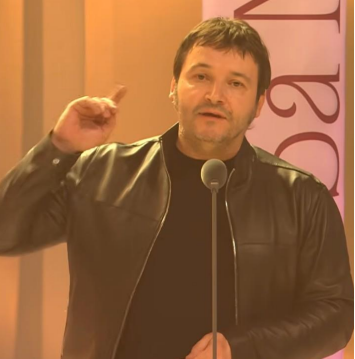
‘If your language is different from your nationality...’
https://www.facebook.com/reel/859932313756191
A big hurray for artists!!
Carles Rebassa
Sud Tirol
Fascist Symbols on the Kehrer Bridge
In South Tyrol, the Kehrer Bridge in the village of Stegen near Bruneck is currently being rebuilt. The original bridge featured symbols of Italian fascism, known as the fasces. During the construction process, there has been discussion about taking these symbols from the old bridge and placing them again on the new Kehrer Bridge. The Südtiroler Schützenbund has clearly spoken out against this. For many people in South Tyrol, these are not simply historical elements, but symbols of oppression and a lasting reminder of the injustice of the fascist regime.
Siegfried Steger
On 21 February 2026, the South Tyrolean freedom fighter Siegfried Steger died. He was the last of the “Puschtra Buibm”, a group of young South Tyroleans who joined the resistance in the 1960s.
The 1960s were a time of great tension in South Tyrol. People were oppressed, and the German and Ladin languages were not allowed to be freely spoken. Many felt treated unfairly in their own homeland and had little say in their future.
In this situation, some people chose to resist. Siegfried Steger was one of them. Together with others, he took part in attacks in which, among other things, power pylons were blown up to draw attention to the situation in South Tyrol.
For many South Tyroleans, he was a freedom fighter who stood up for the rights of his people. From the point of view of the Italian state, however, he was considered a terrorist and was persecuted.
Siegfried Steger had to leave his homeland at a young age and lived for many decades in exile in North Tyrol. He was not able to return to South Tyrol during his lifetime. Only after his death was he allowed to return to his homeland.
At his funeral, thousands of Schützen and many other people were present to pay their last respects.
Euskal Herria
Representation at Unesco
The Government of the Western Basque Country (the Basque Autonomous Community) has recently secured a political development of considerable symbolic importance: from now on, this part of the Basque Country will have direct representation at UNESCO as an associate member.
UNESCO currently comprises 194 member states and 12 associate members. With this change, the number of associate members will rise to 14, as Catalonia will also gain its own representation within UNESCO.
Associate members of UNESCO may take part in the organisation’s conferences and activities, although they do not hold voting rights. The Vice-President of the Basque Autonomous Community has stated that this status will allow the Basques to strengthen their influence in matters relating to their language and culture.
Basque athlete withdraws from the Spanish National Team
The Basque athlete Marko Usabiaga, European junior champion in the OCR discipline, has announced that he will not take part in the upcoming European Championships as he refuses to compete on behalf of Spain.

Over the last 30 years, a number of Basque athletes have declined to represent the Spanish national team across a range of sports, including football, athletics, rugby, surfing and Basque pelota. They have consistently faced fines and sanctions and their professional careers have been put at risk. Similarly, Basque athletes from the northern part of the country have refused to represent the French national team for the same reason: ‘Basques are neither Spanish nor French’, to borrow Orson Welles’s well-known remark; all those Basque athletes wish to compete internationally at sporting events under their own national identity, with their own Basque national teams.
Marko Usabiaga’s decision has received significant coverage in both the Basque and Spanish media.
Scotland
Small independent nations can be peace-makers
While all of us will be thinking about developments in our own countries, we cannot escape the implications of international conflict. The awful brutality of the US/Israeli war and its economic impact must not frighten us into 'cowering down' and retreating from big change, On the contrary, it strengthens the need to move away from imperialist powers and those dominant European states who appear to have little vision apart from holding on to the status-quo.
It is so important for us to have examples of small nations supporting peace-making, international law and cooperation. There are many small nations who perform way above their size and can hold their heads high.
Switzerland is a global hub for international governance. It hosts 40 international agencies and 420 NGOs, notably the UN, the WHO, the International Committee of the Red Cross, the WHO, the ILO. Austria hosts one of the four UN Headquarters, the IAEA, OPEC, the Centre for International Dialogue. It is estimated that the sector secures 20 thousand jobs in Austria. Ireland has served four times on the UN Security Council. It is the only nation with a continuous presence on UN-mandated peace support operations since 1958. Luxembourg hosts the UN Court of Justice and is a key centre for international law and finance. Over the years many of us have looked to the Stockholm International Peace Research Institute to provide us with objective information and analysis.
Beyond Europe, what an outstanding role Costa Rica has played in working for environmental sustainability and nuclear disarmament. Being small can be a strength. We are unlikely to present an imperialist threat.
There are many groups in Scotland who have the vision of an independent nation which can play a positive, non-violent international role which prioritises justice and peace.
Vlaanderen
Belgium stays 'failed state', also with a Flemish (N-VA) prime minister in charge.
The latest outlook from the Federal Planning Bureau confirms what an increasing number of Flemings are sensing: not only is the federal budget going off track, but the Belgian economic model itself is showing structural cracks. Despite announced reforms, the budget deficit continues to rise and is expected to increase further by 2026, while public debt and structural expenditures keep growing. Ageing demographics, rising healthcare costs, and weak economic growth are exposing the underlying weaknesses of the Belgian system. At the same time, Belgium is losing competitiveness due to high labour costs, heavy regulation, and a weakening industrial base, making the economic engine increasingly fragile.
From a Flemish-national perspective, this report once again illustrates that Flanders remains trapped in a federal model that proves difficult to reform and that slows economic dynamism. Even Prime Minister Bart De Wever recently acknowledged that continuing to pursue the Belgian path entails risks: as long as fundamental decision-making power remains fragmented and financial responsibility does not align with economic strength, stagnation becomes a real danger. The Planning Bureau’s analysis therefore implicitly reinforces a central Flemish argument — without structural autonomy and full policy control, Flanders risks being drawn into a system that fails to provide adequate answers to the challenges of the future.
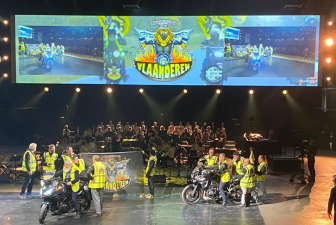
Flemish National Song Festival 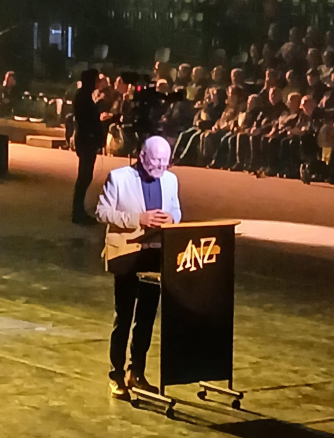
During the Flemish National Song Festival fifteen march, -where 3000 Flemish nationalists gathered together to sing-, ANZ chairman Bart Fierens delivered a strongly community-focused speech in which he called for a profound reform of Belgium’s state structure and greater Flemish autonomy. He argued that necessary state reforms have been “kept in the freezer” for far too long and advocated an evolution toward a new Flemish state formation, including through the division of the social security system. Fierens sharply criticized the political and financial situation in Brussels, which he described as suffering from an unworkable governance model and high levels of debt, and he urged the Flemish movement to increase pressure and consistently pursue its political ambitions. His speech once again framed the Song Festival as both a cultural and political moment, where collective singing is linked to a clear message about Flemish self-determination and a vision for the future.
Cymru
Letters from Friends: Wales at a Political Crossroads
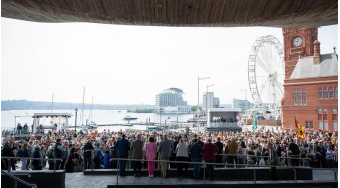
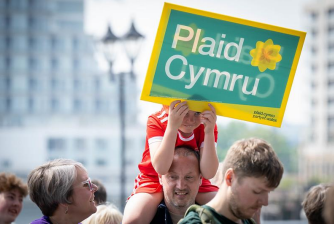
The Senedd elections in May have transformed the political landscape in Wales in a way that would have seemed unimaginable only a decade ago. Plaid Cymru's victory ended a long period of Labour dominance and delivered Wales its first ever pro-independence government in Cardiff Bay. In many respects, however, winning the election was the easy part. The real challenge now begins: governing effectively and demonstrating that an alternative to unionist politics can deliver meaningful improvements to people's lives.
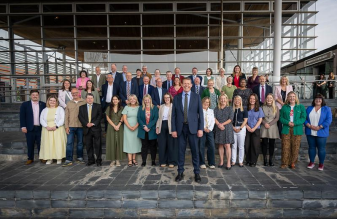 Plaid Cymru faces a particularly demanding timetable. The Senedd term has been reduced from five years to four, giving the new government one year less to make a tangible difference before facing the electorate again in 2030. Welsh voters have already shown their willingness to remove governments that fail to meet expectations. If Plaid cannot deliver visible progress, it risks suffering the same fate as the Labour administration it replaced.
For a party whose raison d'être is Welsh independence, Plaid Cymru has remained relatively cautious about the route towards achieving it. The party's clearest commitment has been that it will not seek an independence referendum during this first Senedd term. While that approach may reassure some voters, it leaves unanswered questions about the longer-term roadmap.
Nevertheless, the broader picture for the independence movement remains encouraging. Public support for independence continues to grow, and the election of a pro-independence government has given the cause unprecedented legitimacy. For the first time in Welsh history, nearly half of Members of the Senedd - 47 per cent - represent pro-independence parties. Even among those who do not currently support independence, there is evidence that many are increasingly comfortable discussing the possibility. Alongside this sits a substantial and growing cohort of "indy-confident" citizens willing to advocate openly for Welsh statehood.
Wales is still some distance from securing an overwhelming majority for independence, but the trajectory is positive. The responsibility now rests firmly with Plaid Cymru. If it can govern successfully, improve public services, strengthen the economy and build confidence in Welsh institutions, it may create the foundations for a decisive shift in public opinion and a renewed push towards independence in the years ahead.
The future, however, remains binary. One path sees a successful Plaid Cymru government building momentum, winning re-election in 2030 and advancing Wales steadily towards independence. The other sees a government that fails to meet expectations, opening the door to a resurgent right-wing, pro-unionist movement and setting the independence cause back by a generation.
For those who believe in Wales's national future, there is much reason for optimism but also every reason to recognise the scale of the challenge ahead. Let us hope that Wales chooses the former rather than the latter.