
- News
This bi-monthly news from a range of European stateless nations. February guest: A letter from Greenland.

February 2026
Greenland
How do you describe the struggle for independence, in a world where the world’s biggest superpower insists on taking over ownership from another colonial power. The irony is not lost, when Denmark who annexed Greenland in 1953 instead of following UN decolonization resolution, now proclaims “Greenland belong to the Greenlanders”.
International law is clear. The United Nations recognizes the Greenlandic People as a People with the inherent right to self-determination. That right includes full freedom to decide their political status and to shape their own future as a sovereign nation.
We do not want to be Americans. We do not want to be Danish. We want to be Greenlandic.
This is not a demand for permission. It is a declaration of identity, dignity, and destiny.
And even though it is comforting to hear the support for our people in these trying times, this was never a question about choosing Denmark or the US. That binary way of looking at former colonies ended with the establishment of the UN. Fear is a powerful tool to prevent change. We need help assuring the Greenlandic People they have nothing to fear. Neither from the US nor Denmark.
The best hope we have for our people, is for the international community to help dial down the rhetoric that only manages to create fear, and let diplomacy work to enable the Greenlandic People determine their own future. Nor should Danes use these times to try to take away our right to self- determination.
When there is no clear leadership working for establishing independence for the Greenlandic People, but only working to maintain the status quo, it creates uncertainty about our future.
The struggle for independence is difficult when the press and the colonizers insist you should be afraid of words, instead of inaction.
The struggle for independence is difficult when the press and the colonizers insist you are traitors to your country, if you don’t support being a part of the Danish Kingdom.
The struggle for independence is difficult when the press and the colonizers claim cry for independence is akin to wanting to give your country to the US.
We are not a territory. We are not lines on a map. We are not numbers.
We are 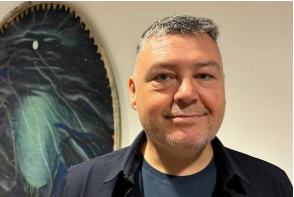 the Greenlandic People. Independence is supposed to be our right.
Pele Broberg
Inatsisartunut ilaasortaq
Scotland
One of the distinctive features of Scotland and its independence campaign is that we are a country in which nuclear weapons are based. We have around 200 nuclear bombs and their Trident delivery system just thirty miles from our largest city.
The UK has posed as one of the world's nuclear powers but since the 1960s, it has been completely dependent on the United States. It makes nuclear warheads and submarines to US design but it has had no independent delivery system for almost 60 years. It rents the Trident missile system from the US and these return regularly to the US for servicing.
This is one of the key reasons why Britain has so often behaved like a client state of the US. Any American President could cancel the lease at any time. With current technology, having Trident subs in Scotland has no strategic advantage to the American military and they will have ensured that they cannot be used without US control. Having an erratic President with contempt for international law and European states makes this a plausible scenario.
However, Britain's nuclear posture has been viewed as hugely important to its politicians who consider itas essential to their 'Big Power' status and they have been committed to spending huge amounts of money in maintaining the illusion. In Scotland the independence movement has always opposed nuclear weapons as an existential threat to humanity and a very real threat to us whether by accident, miscalculation or war hysteria. The SNP and the Greens and all the other independence groups support an independent Scotland ratifying the UN Treaty on the Prohibition of Nuclear Weapons which more than half the member states have signed up to.
This,of course is seen as a threat to the British establishment since there is no 'convenient' site for the Trident base outside of Scotland.
Getting rid of the completely US 'dependent' nuclear system would also be in the interests of the people of England. Money could be spent on the present incompetent defence system. The nuclear weapons are unusable and the over-dependence on the US would decline. This, of course, is a challenge to the false posturing of the British state and there is an attempt which I am sure will be used to attack other independence movements to use the claim that smaller means being weaker. 20th
century history doesn't sustain that argument. Being larger or smaller has not been the key factor in involvement in violence or survival as successful states. We all need a security strategy which focuses on border and cyber defence and environmental and economic resilience. Let's show that we can build soft-power through building networks of friends.
Show our support for our colleagues in Greenland. If the US tries to invade, let's all work for a boycott of the US and turn it into a big campaign.
Isobel Lindsay
Scottish Independence Convention
Països Catalans
Financing Catalonia, an ongoing crushing déjà vu
It doesn't matter when you decide to look at current Catalan politics, you will experience a constant déjà vu, like sea waves on the beach. They can come with more or less violence, but they always come back, repetitively. The same debates, the very same disappointments when dealing with the Spanish state, facts cut off by the same systemic problem: Catalonia not being an independent state.
On January 16, 1641, the President of the Generalitat of Catalonia, Pau Claris (1586 – 1641), proclaimed the Catalan Republic with the aim of maintaining the political independence and freedom of Catalonia in the face of the attempts of the Spanish crown to suppress the sovereignty of the internal kingdoms, including the kingdom of Portugal. Nothing too different from what is happening today, half a millennium later, in the year 2026. Catalans have started the year with an always hot topic: the financing agreement for Catalonia. An agreement negotiated by the Catalan parties with the Spanish government that must necessarily pass through the approval of the entire Spanish Congress. This centralist procedure means that, more than an agreement, it should be called a 'proposal' but that would highlight our crushing and dramatic autonomic subalternism. How much time and resources are wasted with this normalized political filibustering? It’s insulting.
This 'agreement' on the Catalan budget made by ERC with PSOE, enabled Salvador Illa (PSOE candidate in Catalonia) to be proclaimed as the new president of the Generalitat de Catalunya in 2024. And it was also thanks to the investiture agreement between Junts and ERC with PSOE that Pedro Sánchez (PSOE candidate in Spain) was proclaimed president of the Spanish state. Both Catalan 'independentists' parties (ERC and Junts) justified this because it would imply the official status of the Catalan language in Europe and the granting of unique funding for Catalonia, among many other fantasies... because when it comes to putting black on white, we always only see the skeleton of the sardine. When the 'could have been’ is crushed by the Spanish reality, we are only left with history repeating itself and too many Catalan politicians who refuse to learn any lesson.
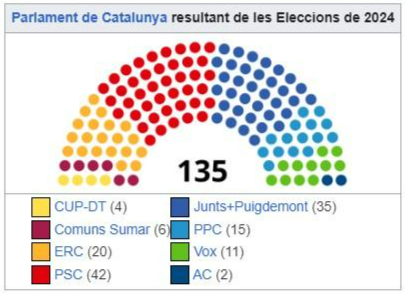
As you can see in the graphic, Junts and ERC had enough votes to try a joint candidacy to win the Catalan Government. They could have responded to the message given by the independentist abstention, which prevented them from having a straight victory. A strong answer, overcoming their internal tensions and showing they understood the message with a 'we hear you, let's go for it' would have reinitiated the spark, they were just not interested. The same way they are not interested in a new approach by keeping the same leadership (people and dynamics) that brought us here.
2026, homage to Catalan Masters.
Fortunately, 2026 will be full of events, conferences, homages to huge names of Catalan culture, an oasis to save ourselves from the 'autonomic' misery we are forced to live in.
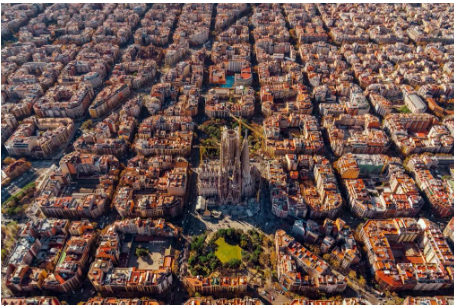
This year's official commemorations will focus on many relevant Catalan names, to highlight three: Idelfons Cerdà (1815-1876), engineer, urbanist, internationally claimed for his grid 'example' of Barcelona; Pau Casals (1876-1973), violist and musical director, author of UN Hymn 1971, and, of course, Antoni Gaudí (1852-1926) architect of Sagrada Familia and many internationally acclaimed modernist buildings. Not many people may know that, in September 1924, Gaudí, very popular already then in Catalonia, suffered the abuse and harassment from the Spanish police for maintaining the Catalan language when he was arrested and taken to a jail cell because of his attendance at the mass in tribute to the fallen of 1714. Yes, before Franco dictatorship, fascism already existed against Catalans. Maybe next time we'll indulge ourselves in going deeper into the work and life of such great names.
To conclude, it is important to note that many initiatives are being organised in Catalonia to sort out this political mess, because, as the Valencian intellectual Joan Fuster (1922-1972) said: ‘All politics we don’t make, will be made against us’ and we had enough of that.
#YESCatalonia
Anna Arqué i Solsona
Spokesperson ICEC – Catalan Countries
Euskal Herria
MUCH MORE THAN A FOOTBALL MATCH
On 15 November 2025, San Mamés Stadium in Bilbao (Basque Country) was filled to capacity, with 51,000 supporters attending the football match between the Basque and Palestinian national teams.
This was far more than a sporting event. It was a powerful political statement with two clear demands: first, the official recognition of the Basque national football team and, secondly, an expression of solidarity with the Palestinian people who are currently suffering a brutal genocide.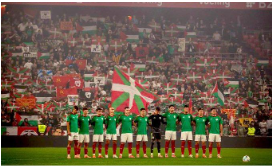
The Basque national football team was founded in 1930 and will soon celebrate its 100th anniversary. It was banned during Generalissimo Franco’s dictatorship, although it continued to play matches in exile. After the dictator’s death, the team resumed its activity. Footballers from across the entire Basque Country represent the team, regardless of administrative borders.
Unlike other national teams from stateless nations—such as Scotland, Wales, or the Faroe Islands—the Basque national team is only permitted to play friendly matches, not official competitions. The reason is straightforward: the Spanish state prevents international federations such as FIFA and UEFA from granting the Basque Country (Euskal Herria) the right to field an officially recognised national team.
Opinion polls consistently show overwhelming support among the Basque population for the official recognition of Basque sports teams.
The Basque team won the match against Palestine 3–0. Yet, beyond the final score, the packed stadium sent an unmistakable message: the demand for a fully official Basque national team and the call to end the genocide against the Palestinian people were loudly and clearly expressed.
MASSIVE PROTEST AGAINST ATTACKS ON THE BASQUE LANGUAGE
On 7 January, Euskalgintzaren Kontseilua, the leading civil organisation working to promote and defend the Basque language, brought together thousands of people at a major demonstration in Bilbao.
The mobilisation aimed to denounce the growing attacks on the Basque language in recent years by the Spanish judiciary and to encourage Basque speakers to organise collectively in defence of their linguistic rights.
Although Basque is an official language in the Basque Autonomous Community (Western Basque Country), numerous court rulings have significantly undermined this status. Some judgments have even declared it illegal to require knowledge of Basque as a condition for employment in the public sector. In practice, this means that Spanish functions as the only fully official language while Basque is relegated to a second-class status.
In response, the Parliament of the Western Basque Country is currently considering the drafting of a new law aimed at preventing such legal abuses. These rulings have been actively promoted by Spanish organisations and trade unions that oppose language normalisation.
Josu Albero
ICEC-Basque Country
Cymru/Wales
Two months on from the last letter from Wales, and the political weather in Wales has shifted perceptibly, and this time it’s not just the rain clouds. Recent polling ahead of the May Senedd elections suggests something genuinely historic: for the first time, openly pro-independence parties could command a majority. Plaid Cymru and the Green Party of Wales are not only holding ground, but advancing- especially among younger voters. This matters. It signals that independence is no longer a fringe aspiration but a mainstream, future-facing proposition, rooted in confidence rather than grievance. The people of Wales are comfortable with the idea of independence – and they are happy to buy into that vision.
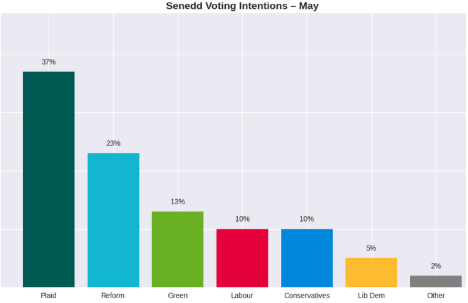
Just as striking is what young voters are rejecting. Despite breathless media claims to the contrary, Wales’s younger generations are politically engaged, do turn out, and are decisively unimpressed by the rhetoric of the far-right populists at Reform UK. Instead, they are voting for cooperation, climate responsibility, and self-government. Zoom out, and the moment sharpens further: it is now entirely plausible that Wales, Scotland, and Northern Ireland could all be governed by parties seeking to end the UK. History, it seems, is being written not in Westminster corridors- but by a generation that was never fooled into thinking the status quo was permanent.
Geraint Thomas
ICEC Cymru
Breizh
Brittany is alive and kicking…
So is Yes Breizh…

After a well-deserved break at the end of 2025, we have initiated our field campaign with a first meeting on January 17th near Brest. We were happy to be able to present Yes Breizh and our objectives to a large audience. The ‘Telegramme’ (the 2nd more popular newspaper in Brittany) had granted us on the same day with an article that helped Bretons to know about our meeting and endeavours.
The next meeting will be … in Rennes on February 6th, and in France, in Paris on the 7th for our diaspora.
But on another theme of our action plan, several working groups are being launched to have Breton answers to ‘bread and butter’ issues (dwelling, transport, health, security, education, etc.;). These working group will bring together professionals, experts, and people experiencing difficulties in these domains.
Izold Guegan - YesBreizh
Flanders
The Flemish People’s Movement Financially Silenced by Its Own Parliament
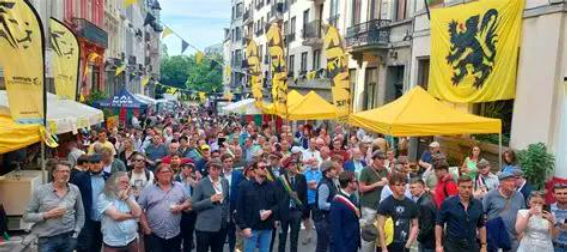
In November, the Flemish government decided to discontinue subsidies for several organizations as of next year, including the Flemish People’s Movement (Vlaamse Volksbeweging, VVB), which will lose nearly €300,000 in funding. The VVB, a Flemish independence organization affiliated with the ICEC, argues that this decision was based on the advice of an assessment committee that failed to take into account essential arguments submitted by the organization—arguments that could have significantly altered the final decision.
According to the VVB, the government did not hold the committee accountable for ignoring these clarifications, constituting a serious breach of good governance. The organization is therefore bringing the case before the Council of State. Chairman Michael Discart denounces the withdrawal of subsidies as a political choice rather than a neutral administrative measure, describing it as an attempt to financially strangle an organization that has defended Flemish rights for over seventy years. While the decision is a major blow, the VVB states that it now has the freedom to speak openly, without sparing any political party or government cabinet.
Language Rights Violations in Brussels Emergency Healthcare
Alongside this legal battle, the VVB continues to highlight persistent language violations in the emergency departments of Brussels hospitals, where Dutch-speaking patients are frequently unable to receive care in their own language. Being denied assistance in one’s mother tongue during moments of panic or vulnerability leads not only to frustration and fear, but also to medical errors, sometimes with fatal consequences. This situation violates patient rights and contravenes the Belgian language law of 1966, which requires emergency services in Brussels hospitals to be bilingual. Through its reporting platform taalklachten.be, established with Flemish government funding, the VVB has already collected around 200 complaints and initiated legal actions, inspections with bailiffs, and cases before the Standing Committee for Language Supervision, some of which have been upheld. The organization aims to raise awareness, support victims, and ultimately enforce language rights through the courts, arguing that decades of political appeals have yielded little result. In January 2026, the VVB also sought the support of mayors in the Halle–Vilvoorde region, stressing that access to healthcare in one’s own language is a matter of safety, legality, and human dignity.
Bart De Valk
ICEC Vlaanderen
Sud Tirol
Olympic Games in South Tyrol and historic Tyrol, Cortina – Milan 2026
From 6 to 22 February 2026, the Olympic Winter Games will take place in many parts of historic Tyrol. Four venues are located in historic Tyrol:
- Cortina d'Ampezzo (curling, bobsleigh, luge, skeleton, alpine skiing)
- Antholz – South Tyrol (biathlon)
- Predazzo – Welschtirol (Nordic combined, ski jumping)
- Tesaro – Welschtirol (Nordic combined, cross-country skiing)
Only Milan, Livigno and Bormio are located outside the historical borders of Tyrol.
However, public, international and local reporting reveals little to nothing about the cultural, political or historical characteristics of the region. Throughout the entire area of historic Tyrol, German, Ladin and, to a limited extent, Italian are still spoken. All official communications are conducted exclusively in Italian; even officially recognised German names such as Antholz (instead of Anterselva) did not appear on a single official portal until a few days ago.

The Schützenbund (the head organisation of ICEC South Tyrol) has attempted to publicise these grievances and has actually succeeded in getting the official German name ‘Antholz’ to appear alongside the Italian name ‘Anterselva’ (invented by the fascists) in official channels just a few days ago. For weeks, various organisations are calling for Ladin flags to be flown throughout the Ladin-speaking region from 6 to 22 February to make it clear to international visitors that this part of the country is not exclusively Italian.
In South Tyrol, people are also trying to use Tyrolean flags to take a stand against the oppressive Italianisation of the area under the guise of sport. The South Tyrolean Rifle Association points out that the original German and Ladin names of the Alpine region are well documented historically, especially in English-speaking countries. The pioneers of Alpine tourism in the 19th century – especially British mountaineers and travel writers – naturally used the place and mountain names that were common at the time. The artificial names introduced later by Ettore Tolomei played no role at that time. The South Tyrolean Schützenbund calls on those responsible at olympics.com to use historically established place names correctly and equally, to show linguistic sensitivity towards minorities and, in particular, to refrain from ideologically biased reporting in German and English. The Olympic Games must not become a stage for national historical falsification.
Andreas Kostner
ICEC Sud Tirol
_______________________________________________________________