
- News
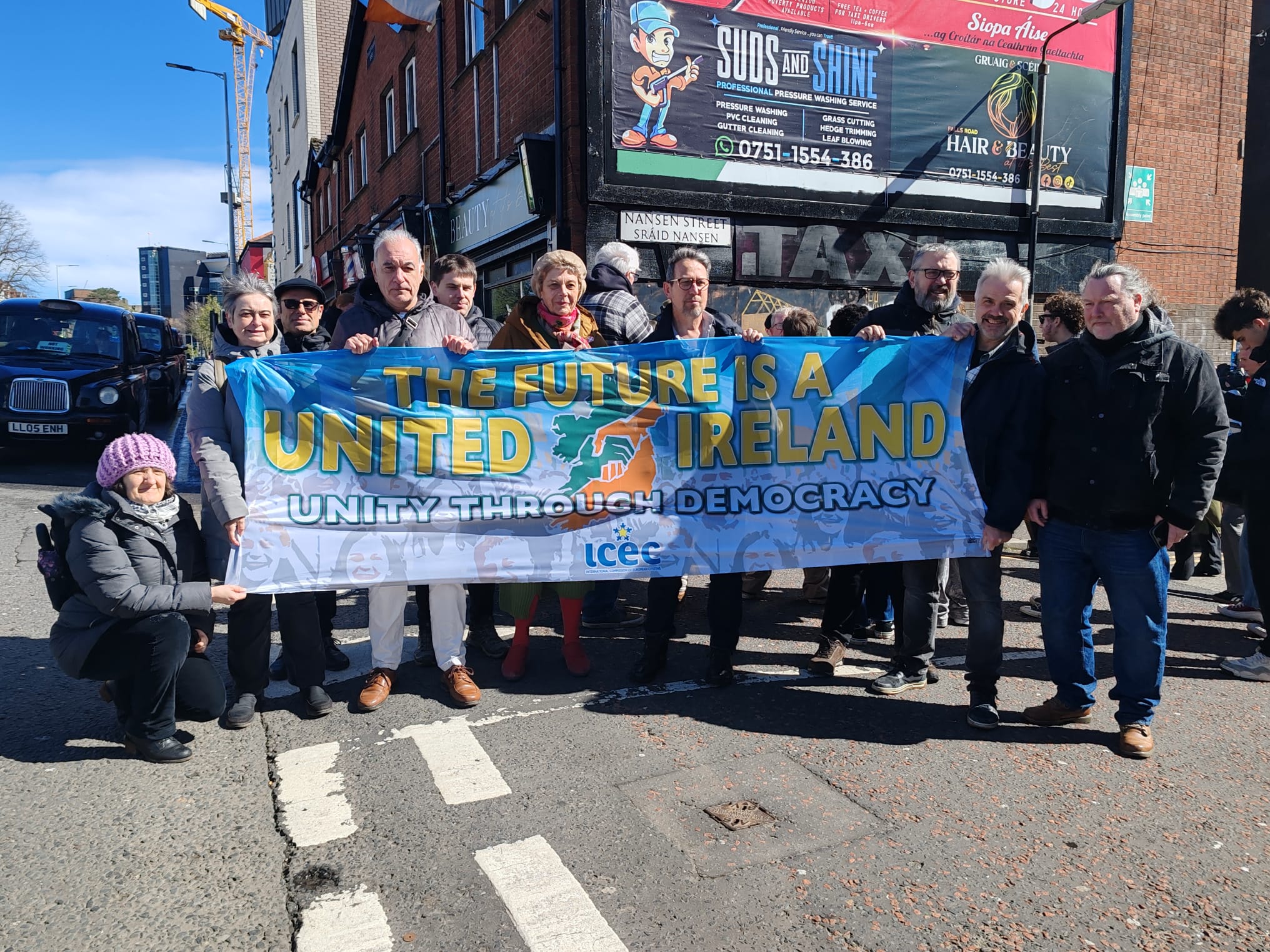
An ICEC delegation visited the North of Ireland over the Easter holidays to strengthen ties with the republican movement
From 2 to 6 April 2026, a large delegation from ICEC visited the North of Ireland . The purpose of this visit was threefold: to learn about the situation of the local language (Irish); to gather information on the current state of the process towards Irish unity through our contacts within the republican movement; and to take part in the events and the demonstration on 5 April, marking the anniversary of the Easter Rising.
On 4 April, we held two highly informative meetings in Belfast with prominent language activists: with Séanna Walsh and Bróna Haughey, Sinn Féin’s language officers.
These meetings provided valuable first-hand insight into the work being carried out to promote Irish in the Six Counties of the North of Ireland. Following a long campaign spanning many years, the Identity and Language Act was passed in 2022, granting Irish a status comparable to that of an official language, although not full official status, as is the case with Basque, Catalan or Welsh.
Sinn Féin councillors Séanna Walsh and Bróna Haughey shared several key figures to help us better understand the current situation of the Irish language in the Six Counties. They noted that around 11% of the population report some knowledge of Irish, with approximately 3% speaking it fluently. In the education sector, Irish-medium immersion schooling comprises 30 schools, serving around 8,000 pupils (2.5% of the total). They also highlighted the growing social demand for Irish, with courses consistently oversubscribed and increasing everyday use in areas such as Belfast’s Gaeltacht Quarter.
In contrast to the Republic of Ireland, where the language movement itself currently lacks momentum, the struggle for the Irish language in the Six Counties remains very much alive, as colonial conditions continue to reinforce national consciousness.
On the afternoon of 4 April, accompanied by veteran activist Robert McClenaghan, we visited Falls Road, a republican neighbourhood in West Belfast, where we took a guided tour of its well-known murals and received detailed explanations of their meaning and historical context.
Unlike in other parts of Belfast, street signs in this neighbourhood were bilingual and Irish flags were displayed throughout. We also spotted ikurriñas (the Basque flag) and esteladas (Catalan pro-independence flag) in different locations. Needless to say, our ICEC’s group and its representatives (Basques, Flemish, Welsh, South Tyroleans...) received a very warm welcome everywhere we went—a clear reflection of the longstanding ties and solidarity between our nations and the North of Ireland.
On 5 April, we took part in the Easter Rising commemorations at the invitation of our local contacts. We marched through Belfast’s republican neighbourhood to the cemetery, where a commemorative ceremony and political rally were held in support of a united Ireland.
It should be recalled that, following the 1998 Good Friday Agreement, the North of Ireland was granted the right to freely determine its political future -a right recognised by the United Kingdom. When we asked local nationalists about the timing of a referendum on Irish unity, they pointed to a timeframe of around five years.
Will 2031 be the year of Irish unity? Let us hope so and may that process also strengthen our nations’ path to Independence.